1. Inhalt
  2. Navigation
  3. Weitere Inhalte
  4. Metanavigation
  5. Suche
  6. Choose from 30 Languages
Wrong language? Change it here. DW.DE has chosen English as your language setting.

Berlin

East Side Gallery: Developer halts removal of Berlin Wall

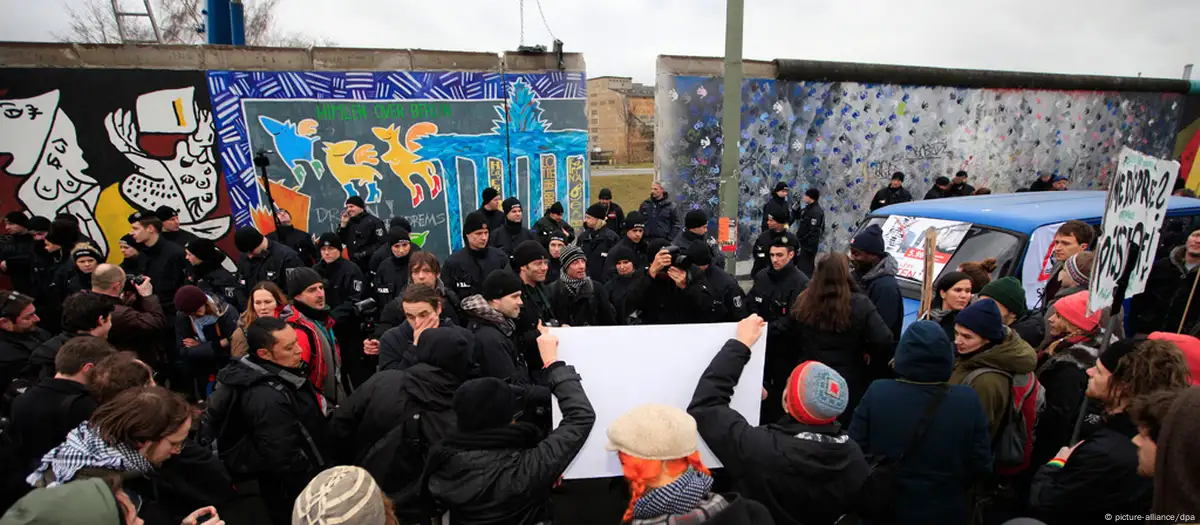
A real estate developer in the German capital has put on hold the removal of parts of the remaining sections of the Berlin Wall. Angry protesters had prevented workers from dismantling the "East Side Gallery."

A property developer in Germany at the centre of protests against some of the remains of the once-detested Berlin Wall being knocked down said on Monday that the dismantling had been temporarily halted.

Volker Thoms, a spokesman for project investor Maik Uwe Hinkel, said removal work had been put on hold until at least March 18.

Maik Uwe Hinkel, the head of the company Living Bauhaus, had previously told the "Berliner Zeitung" newspaper that he was open to compromise.

"The crane has been taken away. We won't move any more wall segments for the time being," he said.

This followed protests on Friday, when hundreds of people prevented construction workers from removing sections of The Wall to make way for a path to a planned luxury housing project.

The number of protesters swelled over the weekend to several thousand.

Few Wall segments remain

Since most of the infamous Berlin Wall was torn down following German reunification in 1990, the longest remaining section is now the stretch known as the "East Side Gallery."

Artists have covered it in recent decades with brightly colored graffiti-type murals. They include the famous "Fraternal Kiss" which depicts Soviet leader Leonid Brezhnev and his East German counterpart Erich Honecker kissing mouth-to-mouth.

  • East Side Gallery Abriss Berlin

    Protests mark destruction of East Side Gallery

    Hole in the wall

    There's a hole in the world-famous Berlin Wall East Side Gallery since Friday (March 1, 2013). As protesters looked on, a crane tore away a painted section of the gallery - the largest and most well-known surviving piece of the Berlin Wall. The art on the wall dates from 1990, when 118 artists from 21 countries came to paint their excitement about the fall of the wall onto the bare concrete slabs.

  • Flash-Galerie East Side Gallery

    Protests mark destruction of East Side Gallery

    Mile-long artwork

    "Hinterland Wall" was the name given to the wall behind the Spree River, the actual border between former East and West Germany. For 1316 meters (4317 feet), the East Side Gallery runs from Berlin Ostbahnhof to Oberbaumbrücke. It's been protected as a memorial since 1991.

  • Flash-Galerie East Side Gallery

    Protests mark destruction of East Side Gallery

    Fading myth

    Over the years, the irreversible march of time has affected the artwork. Fumes from car exhaust and souvenir-hunting tourists have left their mark, damaging the paintings. In 2009, the 20-year anniversary of the fall of the wall, large-scale restoration work of the gallery took place.

  • Flash-Galerie East Side Gallery

    Protests mark destruction of East Side Gallery

    Walls in our heads

    Some works of art have been destroyed, or painted over with graffiti. An initiative using private and public funds was established to restore the pictures on the wall. "It's about tearing down many walls," wrote Ines Bayer in 1989 on her contribution to the East Side Gallery.

  • Flash-Galerie East Side Gallery

    Protests mark destruction of East Side Gallery

    Back to concrete

    During renovation in 2009, old coats of paint were removed through high-pressure steam cleaning. Then the concrete was repaired so artists who participated in 1990 and were still around could repaint their images. After steam-blasting, what remained was bare concrete, which is how the Berlin Wall looked before it fell in November 1989.

  • Flash-Galerie East Side Gallery Berlin

    Protests mark destruction of East Side Gallery

    Artistic messages

    Two peace doves in Picasso's style gently float carry a red ribbon holding a miniature version of the Brandenburg Gate. Artist Rosmarie Schinzler applied just by chance for the opportunity to take part in the historic act of creating the East Side Gallery in 1990.

  • Flash-Galerie East Side Gallery Berlin

    Protests mark destruction of East Side Gallery

    Famous kiss

    When Leonid Breschnew, leader of the Communist Party of the Soviet Union, and East German leader Erich Honecker shared an intimate kiss on the lips, the picture went around the world. "Brotherly Kiss," painted by Moscow artist Dmitry Vrubel, is one of the most famous works of art in the East Side Gallery.

  • Flash-Galerie East Side Gallery

    Protests mark destruction of East Side Gallery

    Tourist attraction

    The gallery is a must-see for visitors to Berlin. With millions of tourists flocking to the East Side Gallery, it is the second-biggest tourist attraction, after the Brandenburg Gate. Fashion designer Daniel Rodan even designed a matching wardrobe, which he presented in front of the remainder of the wall.

  • Flash-Galerie East Side Gallery

    Protests mark destruction of East Side Gallery

    Breakthrough

    The Trabi driving through the wall - a painting which earned artist Birgit Kinder worldwide fame. The Trabant was produced in the GDR starting in 1957 by car manufacturer VEB Sachsenring Automobilwerke Zwickau. More than 3 million Trabants, or Trabis, were produced between 1957 and 1991.

  • Flash-Galerie East Side Gallery

    Protests mark destruction of East Side Gallery

    Symbolic figure

    In 1970, Andrei Dmitrijewitsch Sacharow founded a committee to enact human rights, and in an open letter to the government, demanded democracy in the Soviet Union. Sacharow was awarded the Nobel Peace Prize in 1975. The Soviet government forbade him from traveling to the ceremony in Oslo.


    Author: Sabine Oelze / jlw | Editor : Sonya Diehn

The 1.3 kilometer (0.8 miles) long and 3.6-meter (11 foot) high stretch of The Wall is one of Berlin's main tourist attractions, as few relics of Berlin's 28-year-long division still exist.

Developers had planned to tear down a 22-meter segment of the "East Side Gallery" to provide safe access to the residential development site on the banks of Berlin's Spree river as well as access to a planned bridge.

But the developer has said that the removal of The Wall was not absolutely necessary.

Constructed in 1961, the Wall stretched 155 kilometers (96 miles) and divided Berlin until 1989, but today only around three kilometers of it still stands.

rg/ipj (dpa, AFP, AP)

DW.DE

Audios and videos on the topic