1. Inhalt
  2. Navigation
  3. Weitere Inhalte
  4. Metanavigation
  5. Suche
  6. Choose from 30 Languages

Art

New Gerhard Richter film reveals painter's secret process

The German painter Gerhard Richter has long been considered one of the most significant contemporary artists in the world. A new documentary film offers a rare glimpse of the artist at work in his studio.

Gerhard Richter at work

Richter's studio is usually off-limits

"Somehow the paintings just do what they want to do," declares Gerhard Richter in a scene from the new film "Gerhard Richter Painting" by filmmaker Corinna Belz.

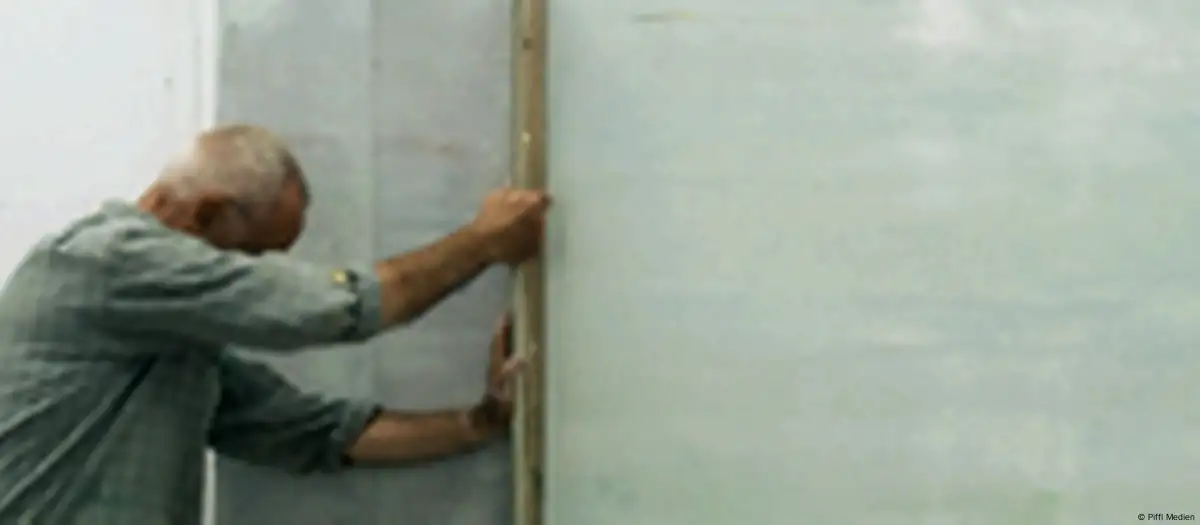
Chance is a large part of the 79-year-old German artist's creative process, but the method is always the same. His paintings are the results of a long and careful process. Richter applies layer upon layer of color to the canvas in a manner similar to that of a plasterer working on a wall. Sometimes Richter will use a paintbrush, but he mostly works with a large wooden plank - a giant squeegee - enabling him to cover vast areas of canvas with paint.

Corinna Belz filmed the artist at irregular intervals over a period of months at work in his two studios in Cologne observing his preparations for a series of exhibitions in Cologne, London and New York. Richter's creative reclusiveness is what distinguishes him from other contemporary artists making the presence of a camera team somewhat of an experiment for him.

A painting in progress, by Gerhard Richter

Richter has worked in a wide variety of styles

"We didn't pretend as if we weren't there and neither did he," Belz told DW-TV, "That's a good way of dealing with it."

The savior of painting

Alongside his work in the studio, the film also explores the connection between Richter's personal history growing up the communist East and his stylistic vocabulary, which oscillates between the purely abstract and a type of photographic realism. After experiencing the extremes of both the propagandistic art of the Nazi regime and then the politically dogmatic state-sponsored art of the former German Democratic Republic, Richter had become disillusioned with painting.

Shortly before the erection of the Berlin Wall in 1961 he fled with his wife and one suitcase from his home town of Dresden to West Germany. There he studied at the State Art Academy in Dusseldorf under Karl Otto Gotz and began working relationships with the artists Sigmar Polke and Georg Baselitz.

At a time when many artists were turning to installation and performance art, Richter was gaining an international reputation as the savior of painting, bringing new creative energy to the discipline. Richter described his photo-realist style of painting as "Capitalist Realism," his works often drawing on subject matter taken directly from print media.

The gray color palette of his famous Stammheim Cycle paved the way for a series of monochromatic paintings produced during the 1970s. Richter once commented that the gray tones provoked contradiction through the representation of a sense of "hopelessness, desolation and a lack of partisanship."

Stained glass for Cologne

A painting in progress, by Gerhard Richter

The birth of a masterpiece

Richter would not return to East Germany for over 20 years. In West Germany, Richter rapidly established himself as one of the most internationally significant artists of his generation. His works hang in galleries and museums across the globe with collectors willing to pay millions for just one pieces. But Gerhard Richter's art has not only impressed the global art scene: In 2007 the Catholic Church commissioned the artist, who currently lives and works in Cologne, to design a new stained-glass window for the Cologne Cathedral.

It was while Richter was at work on the window that filmmaker Corinna Belz was able to film him at work for the very first time. During filming, Belz slowly but surely gained his trust. Richter is known for being a particularly media-shy artist who very rarely gives interviews. As such, "Gerhard Richter Painting" provides an extraordinarily rare glimpse into the artist's creative process in his studio, which is normally never open to strangers.

Glimpse at the 'secretive affair'

In the film, Richter declares painting to be "a secretive affair," although the remarkable 101-minute documentary film quite literally peers over the artist's shoulder, observing every stroke of the brush. We see how Richter drags a giant squeegee loaded with color over the canvas and later carefully works at stripping away layers of paint with stunning sound effects. The streaks of color sometimes bleed into one another, creating unexpected tonal nuances, or form large opaque areas of canvas over dried sections of the work.

To begin with, Richter smears layers of paint all over the canvas, and then stands back and lets them work on him. "The critical way in which he looks at his pictures and being able to look at his pictures with him, that's what I found the most interesting," said Belz.

Richter only stops work on a painting at the point at which "nothing else is wrong," he tells his friend, art historian and critic Benjamin Buchloh during a visit to his studio in the chic district of Hahnwald in Cologne.

'I believe in nothing'

Gerhard Richter

Richter is one of Germany's most renowned living artists

Two assistants help Richter with his work, filtering colors and assisting with the hanging of paintings on the walls. A studio coordinator is responsible for dealing with exhibition requests, transportation of works and fending off the press. Richter prepares for his exhibitions fastidiously, hanging photographs of his paintings in small, self-made architectural models of each museum or gallery. This enables him to decide upon the exact positioning of each work inside the gallery space.

Richter once said it was almost impossible to describe the act of painting and throughout the movie he remains tight-lipped. He is famously critical of ideological thinking, once declaring "I believe in nothing." Throughout the film he responds to questions from Belz with only a limited number of words, appearing reluctant to offer any definitive interpretation or art-historical account of his works.

The film focuses instead on the act of painting, with a series of detailed close-ups of gloopy, wet paint being swept across the canvas. But what does the artist himself think of the film? "It's good, because it's so boring!" says Richter, smiling. "It is so quiet and unassuming. It's similar to an exhibition - you want to show what it is that you do."

Author: Sabine Oelze / hw

Editor: Kate Bowen

dw.de

Audios and videos on the topic

  • Happy birthday

    Happy Birthday Cannes

    Happy birthday

    The most famous film festival in the world is celebrating its 65th birthday - it's a pensionable age, but Cannes is showing no signs of slowing down. The latest edition offers the usual glamorous circus of film stars, red carpets and galas, while the official festival poster features Marilyn Monroe, whose death 50 years ago will also be commemorated.

  • The Croisette all spruced up

    Happy Birthday Cannes

    The Croisette all spruced up

    Unlike February's Berlin Film Festival, Cannes always offers fantastic weather – an advantage not to be underestimated. The Cote d'Azur boasts perennial sunshine, which helps to attract stars from around the world, and the Hollywood glitterati are always welcome adornments to the red carpets. This year, Bruce Willis, Nicole Kidman, Brad Pitt and Reese Whiterspoon are all expected to attend.

  • Homegrown cinema

    Happy Birthday Cannes

    Homegrown cinema

    Of course, the competition for the Golden and the Silver Palm is always a showcase for new French cinema. Festival director Thierry Fremaux has invited several French films into this year's competition, including works by Jacques Audiard, Alain Resnais and Leos Carax. The latter is showing his eagerly anticipated "Holy Motors" (pictured).

  • Cronenberg, the Canadian auteur

    Happy Birthday Cannes

    Cronenberg, the Canadian auteur

    When Canadian director David Cronenberg has a new film to show, the world's biggest festivals fight over it. Cannes traditionally has the best chances, and it won out again this year. "Cosmopolis", based on a novel by Don DeLillo, is about all the things that can happen to a stockbroker on his way to the hairdresser - including a chance meeting with Juliette Binoche.

  • Red carpet fashion show

    Happy Birthday Cannes

    Red carpet fashion show

    Premieres begin with the parade along the famous red carpet. Photographers shriek to lure the best poses from the stars, while reporters plead for a short statement. And, of course, the eyes of the world are on the stunning wardrobes of the actresses - as last year, when Chinese actress Fan Bing Bing graced the Croisette.

  • An Iranian regular

    Happy Birthday Cannes

    An Iranian regular

    Iranian filmmaker Abbas Kiarostami, born in 1940, has been a Cannes regular for many years, and he won the Golden Palm 15 years ago. His new film "Like Someone in Love" is also in this year's competition. The French-Japanese co-production details a mysterious meeting between a young woman and an old man in Tokyo.

  • Great Danes

    Happy Birthday Cannes

    Great Danes

    Denmark has been a cinematic superpower for many years, and this year's Cannes is graced by the latest work from Thomas Vinterberg, who won the Jury Prize in 1998 for "Festen." Vinterberg's 2012 offering "Jagden" features Mads Mikkelsen (pictured) playing a man who believes he faces false accusations of pedophilia. Child abuse was also a theme of "Festen."

  • The jury

    Happy Birthday Cannes

    The jury

    Italian director Nanni Moretti, who won the 2001 Golden Palm for "The Son's Room," is the president of this year's Cannes jury. He is joined by German actress Diane Kruger, US director Alexander Payne and French fashion designer Jean-Paul Gaultier. They decide who gets the big prizes this year.

  • Bleak work from Ukraine

    Happy Birthday Cannes

    Bleak work from Ukraine

    Ukrainian director Sergei Loznitsa has also been invited to Cannes once again, after showing his debut "My Joy" in 2010. His new work "In The Fog" is set in 1942, and depicts scenes from the Soviet front in World War II. It is a German-Dutch-Lithuanian-Russian co-production.

  • Global co-productions

    Happy Birthday Cannes

    Global co-productions

    More and more films are now made with money from several countries – often on different continents. One example of a "global" production like this is "Post Tenebras Lux," by Mexican director Carlos Reygadas. The movie, competing for this year's Golden Palm, was completed with money from the Netherlands, France, Mexico and Germany. It was filmed in Mexico, England, Spain and Belgium.

  • View from America

    Happy Birthday Cannes

    View from America

    Cannes always makes room for big Hollywood cinema. Several studios use the festival as a launch pad for their latest major productions. But the US competition entry "The Paperboy" is a more modest affair, about a falsely convicted man played by John Cusack (pictured). The movie, set in 1960s Florida, promises classic US courtroom drama.

  • A German view of Turkey

    Happy Birthday Cannes

    A German view of Turkey

    Once again, German films are few and far between in Cannes, though Hamburg director Fatih Akin is presenting his new documentary "The Garbage in the Garden of Eden," in one of the festival's sub-sections. The movie charts the struggle of a tiny Turkish village against a giant garbage dump.

  • Cannes turns 65

    Happy Birthday Cannes

    Cannes turns 65

    Over the decades, Cannes has established itself as the world's premier film festival, and around 4,600 journalists are once again expected this year. Unlike Berlin, Cannes is not a people's festival, where the general public gets to see the films. And at no other festival is so much filming and photographing going on. Moreover, few other festivals offer cinema on the beach!


    Author: Ben Knight | Editor: Andreas Illmer