1. Inhalt
  2. Navigation
  3. Weitere Inhalte
  4. Metanavigation
  5. Suche
  6. Choose from 30 Languages
Wrong language? Change it here. DW.DE has chosen English as your language setting.

Democracy

An army of 'yes-men': China's People's Congress

Every March, China's National People's Congress convenes. The constitution calls it the highest government body, and yet, its members have never voted down a bill from the country's leaders.

Self-confidence and assertiveness are not words generally associated with China's highest legislative body. When the National People's Congress (NPC) convenes in March security is tighter than usual around the Great Hall of the People in Beijing.

  • A general view shows the opening ceremony of the National People's Congress (NPC) at the Great Hall of the People in Beijing March 5, 2012. REUTERS/Jason Lee

    China's National People's Congress

    The world's biggest parliament

    The National People’s Congress (NPC) of China serves as the country's parliament and takes place annually in the Great Hall of the People in Beijing. The people choose the representatives who serve at the lower level directly. This lower level, in turn, elects the representatives at the next highest level to the NPC, with about 3,000 members. The NPC membership is elected for a five-year period.

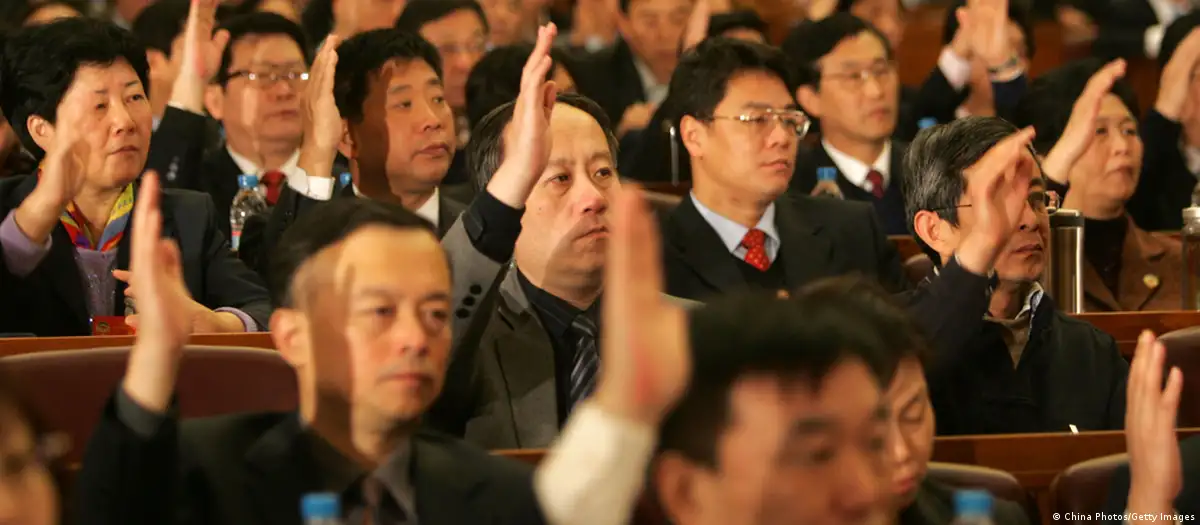
  • Delegates vote during the first Session of the 11th Beijing Municipal Committee of Chinese People's Political Consultative Conference (CPPCC), which opens today on January 19, 2008 in Beijing, China. The Chinese People's Political Consultative Conference is the advisory body to the National People's Congress, or China's parliament. (Photo by China Photos/Getty Images)

    China's National People's Congress

    'Army of hand raisers'

    It is a commonly held opinion among the public that the people's representatives only take part in the congress to give their approval to decisions that have already been made. Because voting once took place with a show of hands, the NPC is often derided as the "Army of hand-raisers." Nowadays, voting takes place using electronic apparatus. Votes in favor make up some 90 percent of the total.

  • A display board shows the voting pattern on the Criminal Procedure Law, with 2639 for, 160 against and 57 abstentions, at the closing session of the National Peoples Congress (NPC) at The Great Hall Of The People on March 14, 2012 in Beijing, China. The National People's Congress (NPC), China's parliament, adopted the revision to the Criminal Procedure Law at the closing session of its annual session Wednesday. (Photo by Feng Li/Getty Images)

    China's National People's Congress

    Representing the people

    This year, the NPC begins on March 5. The current legislative period is coming to an end. The leadership change is to be decided. The duties of the NPC are laid out in the constitution. Among them are making amendments to the constitution and the election and removal of the president, prime minister and ministers. In addition, the representatives are supposed to represent the will of the people.

  • The Dalai and Panchen Lama at the congress (Photo: dpa)

    China's National People's Congress

    Birth of a constitution

    The first session of the NPC took place under the leadership of the founder of the People's Republic Mao Zedong in Beijing in September 1954. It was then the Chinese constitution was adopted. The 14th Dalai Lama (first from right) and the 10th Panchen Lama (second from right), the highest religious leaders of Tibet also took part. They were invited as representatives of the Tibetan people.

  • In this 1956 picture the two spiritual leaders of Tibet, the rival Panchen (L) and Dalai Lamas (R), are shown flanking their 'protector', Mao Zedong, Chairman of the People's Republic of China, in Beijing. Communist China announced 28 March 1959 that it had deposed the Dalai Lama and set up a new government in rebellious Tibet under the Panchen Lama. The late Panchen Lama (1938-89), a spiritual leader and teacher in Tibetan Buddhism (second in importance to the Dalai Lama), was said to be reincarnation of the Buddha Amitabha. He became the ward of the Chinese in his childhood, and some Tibetans disputed his status. Dalai Lama or Tenzin Gyatso, born in 1935, is the traditional religious and temporal head of Tibet's Buddhist clergy . In March 1959, there was an unsuccessful armed uprising by Tibetans against Chinese rule. As a result, the Dalai Lama, fled with some 100,000 supporters to northern India, where a government-in-exile was established. The Chinese ended the the former dominance of the lamas (Buddhist monks) and destroyed many monasteries. Tibet (Xizang), occupied in 1950 by Chinese Communist forces, became an 'Autonomous Region' of China in September 1965, but the majority of Tibetans have continued to regard the Dalai Lama as their 'god-king' and to resent the Chinese presence, leading to intermittent unrest. (Photo credit should read -/AFP/Getty Images)

    China's National People's Congress

    From honored guest to 'traitor'

    After the Tibetan uprising in 1959, in which thousands of Tibetan monks rose up against their Chinese occupation only to be suppressed by force, the Dalai Lama had to flee to India. To this day, Beijing talks of "an armed rebellion of Tibetans against the Chinese government." Since then, the Dalai Lama has been considered a traitor and separatist in China.

  • The Panchen Lama (C), the second highest Tibetan Buddhist leader, arrives the closing session of the National Committee of the Chinese People's Political Consultative Conference (CPPCC) at the Great Hall of the People on March 13, 2012 in Beijing, China. Known as 'liang hui,' or 'two organizations', it consists of meetings of China's legislature, the National People's Congress (NPC), and its advisory auxiliary, the Chinese People's Political Consultative Conference (CPPCC). (Photo by Lintao Zhang/Getty Images)

    China's National People's Congress

    Among the youngest

    While the Dalai Lama had to go into exile, the Panchen Lama continued to be a people's representative at the NPC. His religious successor, the 11th Panchen Lama, is today, at the age of 22, one of the youngest representatives.

  • Police search people outside the Great Hall of the People before the opening session at the 11th National Committee of the Chinese People's Political Consultative Conference (CPPCC) in Beijing on March 3, 2012. China's parliament, also called the National People's Congress (NPC), will open its last annual session under the current leadership on March 5, amid what analysts say may be a bitter power struggle to replace outgoing Communist Party rulers. AFP PHOTO / Mark RALSTON (Photo credit should read MARK RALSTON/AFP/Getty Images)

    China's National People's Congress

    Tight security in Tiananmen

    The NPC lasts for about two weeks and, while in session, there is strict security. The hall is located on Tiananmen Square, where visitors and passers-by have to put up with much more frequent ID and bag checks than usual.

  • Bildergalerie China Volkskongress

    China's National People's Congress

    All a little too tiring…

    While the security forces work in the square outside, there appears to be little of interest going on inside. It's not difficult for a mischievous photographer to find subjects who have fallen fast asleep.

  • Bildergalerie China Volkskongress Bo Xilai

    China's National People's Congress

    From rising star to suspected criminal

    Even the former party chief in the city of Chongqing apparently had to battle with fatigue. This picture is from the last NPC. Could he have known then that one year later he would have been arrested on grounds of misuse of office and corruption?

  • China's Premier Wen Jiabao attends the closing session of the National Committee of the Chinese People's Political Consultative Conference (CPPCC) at the Great Hall of the People on March 13, 2012 in Beijing, China. Known as 'liang hui,' or 'two organizations', it consists of meetings of China's legislature, the National People's Congress (NPC), and its advisory auxiliary, the Chinese People's Political Consultative Conference (CPPCC). (Photo by Lintao Zhang/Getty Images)

    China's National People's Congress

    The outgoing premier

    After the last NPC, outgoing Prime Minister Wen Jiabao held a press conference in front of both Chinese and foreign journalists. It was the last such conference of his period in office. Responding to questions from journalists, Wen clearly indicated that the Chinese government would take the unfolding political scandal in Chongqing seriously.

  • Chinese Premier Wen Jiabao (L) talks with Vice President Xi Jinping (R) after the fourth plenary meeting of the National People's Congress's (NPC) annual session at the Great Hall of the People in Beijing on March 11, 2012. Proposed changes to China's criminal law being debated this week by the parliament originally included a clause that allowed police to hold people suspected of terrorism or endangering national security in secret locations without notifying their families. AFP PHOTO / LIU JIN (Photo credit should read LIU JIN/AFP/Getty Images)

    China's National People's Congress

    Presidential promises

    At the 18th Communist Party Congress in November, 2012, delegates decided upon who should be their new party chairman. Xi Jinping (right) is also to become China's head of state. Xi has stressed several times that he will make the fight against corruption a focus of his agenda. Since then, several high-ranking party officials have been dismissed for corruption or for having extramarital affairs.

  • China's Vice President Xi Jinping (front L) and China's Vice-Premier Li Keqiang (front R) leave their seats after the closing session of 18th National Congress of the Communist Party of China at the Great Hall of the People in Beijing, November 14, 2012. China's Communist Party congress offered the first clues on a generational leadership change on Wednesday as Xi Jinping and Li Keqiang took the first step to the presidency and premiership, respectively. The 2,270 carefully vetted delegates cast their votes behind closed doors in Beijing's cavernous Great Hall of the People for the new Central Committee, a ruling council with around 200 full members and 170 or so alternate members with no voting rights. REUTERS/Jason Lee

    China's National People's Congress

    New era

    The outgoing president announced last year that he would be giving up all his official duties. It is expected that Xi Jinping (left) will be officially chosen as the new president at the NPC, as well as the commander-in-chief of the country's vast army. Serving Deputy Prime Minister Li Keqiang will become the new prime minister.


    Author: Xiegong Fischer / rc

Thousands of extra police are on duty to ensure a smooth and undisrupted meeting of the 3,000 deputies that make up the world's largest parliament.

But size isn't everything, and in this case, does not automatically translate into power. China's legislators don't have much to say in the decision-making process.

What laws and other measures are implemented in the Middle Kingdom are dictated by the leaders of the Communist party.

The legislative period lasts five years in China and the plenary session of the NPC is from March 5-17 this year.

The agenda for the deputies is a marathon of voting to fill key positions, such as the office of president, the National Council, the chief justice of the Supreme Court and the attorney general. The change of leadership, which began last November at the 18th party congress, will then be completed.

No surprises are expected. In its entire history, the NPC has never rejected a law, draft proposal, audit, accountability report, or personnel decision from the country's leadership.

Career deputies

Shen Jilan, (Photo: http://english.globalgujaratnews.com/article/84-year-old-woman-only-chinese-to-be-elected-12-times/A55
Copyright: http://english.globalgujaratnews.com) Shen Jilan has attended every party congress since 1954

The reason for this is that the deputies are not directly elected by the people. Even if it is called the National People's Congress, the representatives are hand-picked at the provincial level by party stalwarts.

The 2,987 parliamentarians for the new legislative period through 2018 were already "elected" in January.

Once again among them is Shen Jilan. The 84-year-old has been a NPC member since the body's inception in 1954 and she is the only person alive today to have attended every party congress.

Shen is also known for her 2010 pronouncement that she has never voted 'no.' This covers the time of the infamous Cultural Revolution, as well as the reform polices of later years. Her reasoning: As a deputy you should obey the party. Former president, Jiang Zemin, once called Shen Jilan a "national treasure."

Dream results

This Xinhua file photo taken in December 2004 shows the aerial view of the Three Gorges Dam in Yichang, central China's Hubei Province. (AP Photo / Xinhua, Du Huaju) The PNC is essentially just a rubber stamp for the decisions of party leaders

Most of the time, votes in the NPC end with very high approval ratings.

One example: During the nomination process for outgoing president, Hu Jintao, in 2008 there were 2,956 'yes' votes, three 'no' votes and five abstentions - an approval rating of more than 99 percent.

Even minimal resistance to the party line is a rare bird in the NPC, but something akin to it did occur in 1992.

During a vote to approve the construction of the controversial Three Gorges Dam on the Yangtze River only 67 percent of the deputies voted in favor of the project. Despite the two-thirds majority, it was a slap in the face for the sitting prime minister, Li Peng.

DW.DE